Data governance for every team that works with data.

OpsMonsters Data Governance catalogs your data, labels what is sensitive and decides who may use it, and for what. Every share and every approval stays on record.

OpsMonsters Data Governance catalog with field classifications, owners and an access policy
One governed data layer for every OpsMonsters product, including:
Data GovernanceAI GovernanceAgent SecurityCompliance ManagementKnowledge ManagementDocument ManagementDigital TrustAgent OrchestrationCustomer EngagementWorkforce PlanningData GovernanceAI GovernanceAgent SecurityCompliance ManagementKnowledge ManagementDocument ManagementDigital TrustAgent OrchestrationCustomer EngagementWorkforce PlanningData GovernanceAI GovernanceAgent SecurityCompliance ManagementKnowledge ManagementDocument ManagementDigital TrustAgent OrchestrationCustomer EngagementWorkforce PlanningData GovernanceAI GovernanceAgent SecurityCompliance ManagementKnowledge ManagementDocument ManagementDigital TrustAgent OrchestrationCustomer EngagementWorkforce PlanningData GovernanceAI GovernanceAgent SecurityCompliance ManagementKnowledge ManagementDocument ManagementDigital TrustAgent OrchestrationCustomer EngagementWorkforce Planning
Label sensitive data at the source.
Fields are classified as they enter OpsMonsters, so personal and restricted data never shows up unlabelled in a report or export.
The right reviewer for every request.
Access requests go to the dataset owner with the purpose attached. Security and legal join in when the classification calls for it.
Decide what leaves and what stays.
Sharing rules set which fields a partner, a supplier or an AI agent can see, per purpose and per region.

Your teams use the data. OpsMonsters keeps it governed.

Catalog, access, quality and retention in one place, so an audit request becomes a lookup instead of a project.

Every dataset has an owner. No orphans.

Each table, file and report in the catalog carries a named owner, a steward and a classification. When someone changes roles, OpsMonsters asks who takes over before access lapses.

Document Management
Two datasets in the OpsMonsters catalog, each with an owner, a steward and classified fields

Answer access requests in one step.

Requests arrive with the dataset, the fields and the reason, so the owner can approve, narrow or decline without an email thread.

Compliance Management
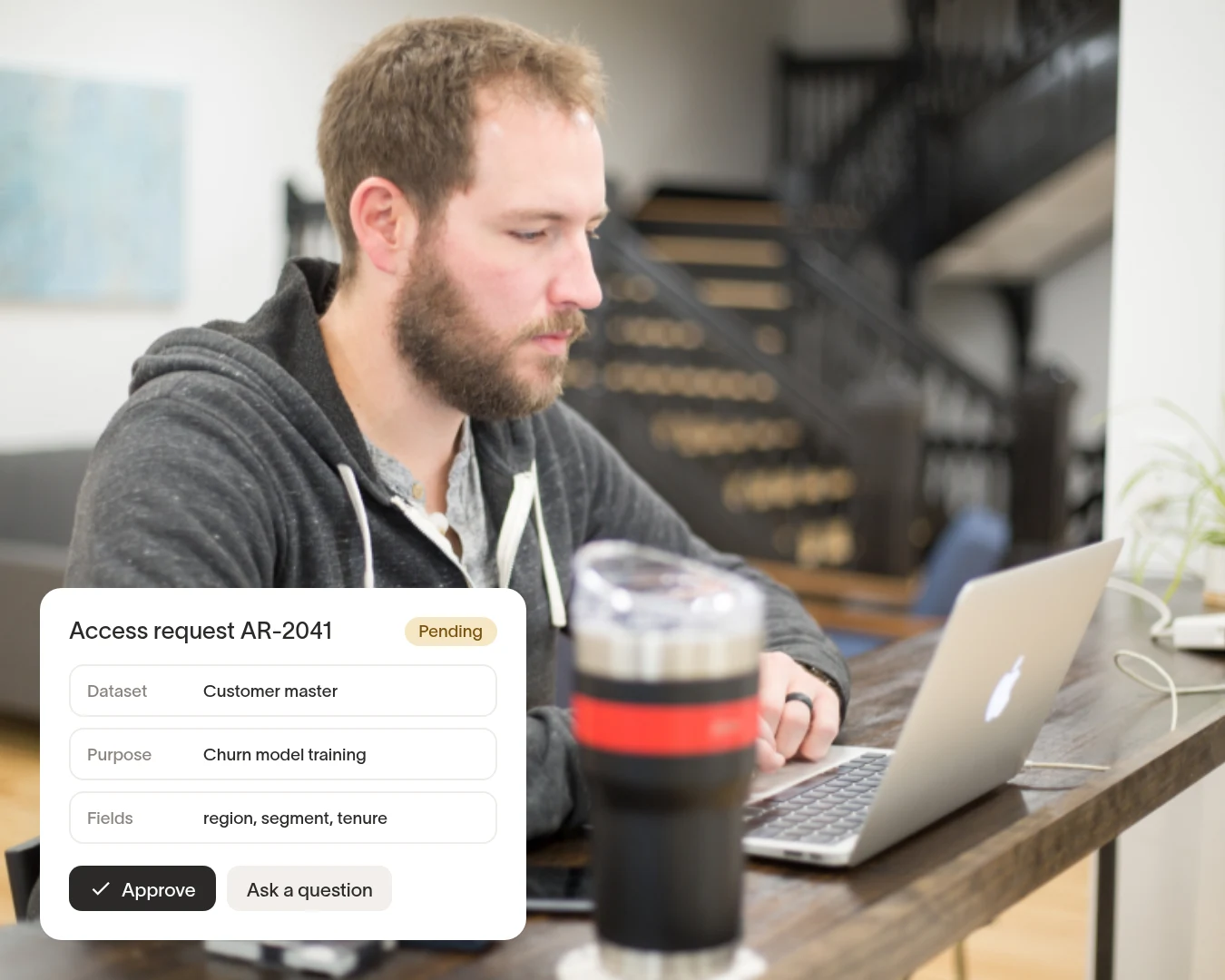
An analyst at his laptop next to a pending OpsMonsters access request for a customer dataset

Set the policy once. OpsMonsters applies it.

Masking, region and retention rules run on every query, export and share. Anything outside the policy is stopped and reported.

Agent Security
A OpsMonsters data policy with alerts for an unmasked export, data outside its home region and passed retention

Spot sensitive data the moment it lands.

New sources are scanned as they connect. Personal, financial and health fields are flagged and sent to the right steward, with no manual sweep.

AI Governance

One register for every data decision.

Replace the spreadsheets that track owners, consents and access reviews with one register that every OpsMonsters product reads from.
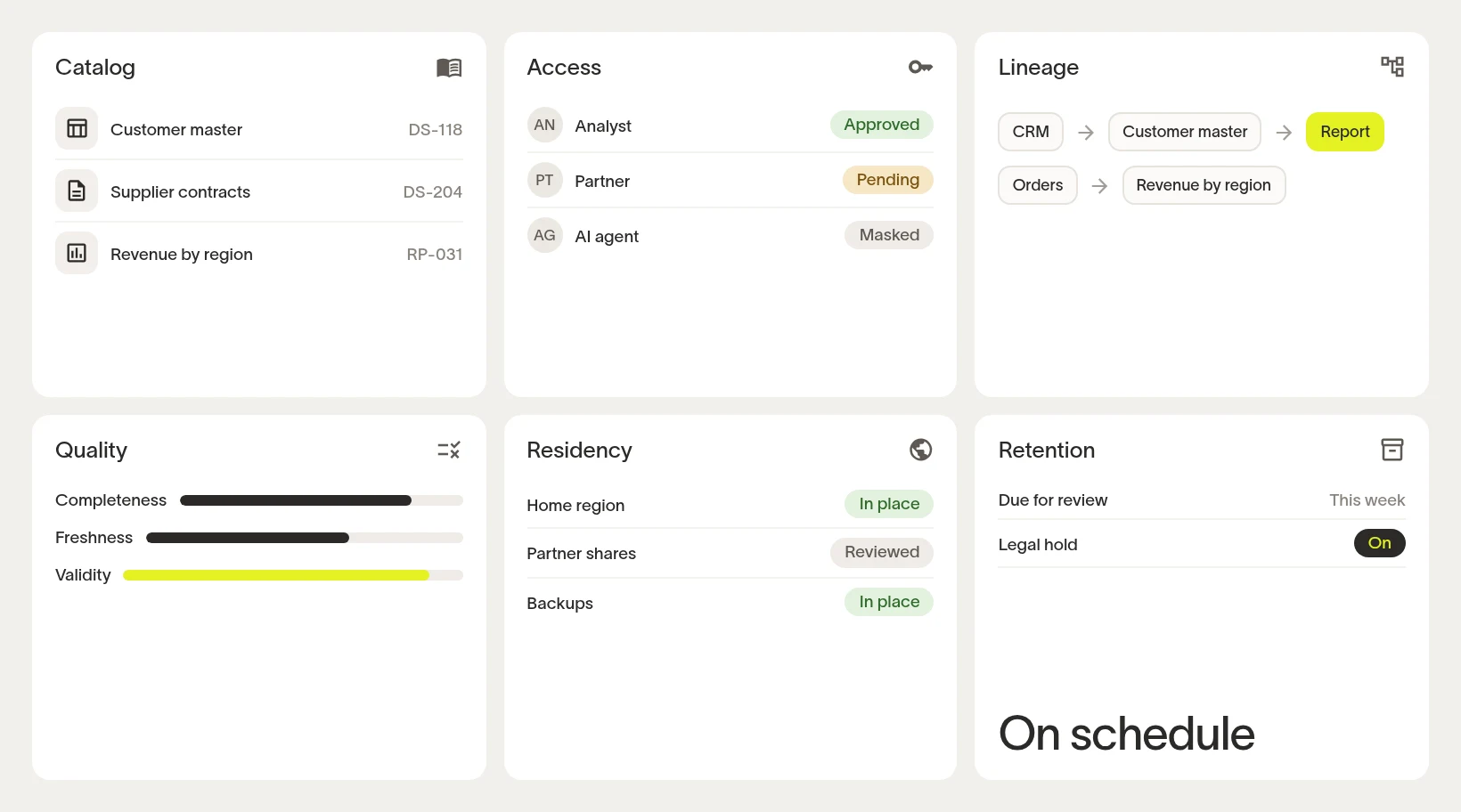
OpsMonsters Data Governance tiles for catalog, access, lineage, quality, residency and retention

“We used to answer audit questions by emailing every team that might know. Now the answer is in the register, with who approved what and when. My team builds data products again instead of chasing evidence.”

Chief Data Officer

Regional insurance group

Chief Data Officer at a regional insurance group
Compliance Management
“Our compliance reviews now start from the same register the data team keeps. When an auditor asks who could see patient contact details last year, we pull the answer instead of rebuilding it.”
Head of Compliance
Regional healthcare network
Data Governance
“Every dataset has an owner we can name and a label we trust. New sources are tagged the day they connect, so nothing reaches a dashboard without a classification.”
Data Governance Lead
National logistics company
AI Governance
“Before a model trains on anything, we can see which fields it may use and why. Our AI reviews got shorter and a lot calmer.”
Head of Machine Learning
Insurance group
Knowledge Management
“Our wikis and document stores follow the same retention rules as our databases now. People find what they need, and what should be gone is actually gone.”
Knowledge Manager
Engineering consultancy
Digital Trust
“Customers ask what we hold about them and who we share it with. Data Governance gives us one place to answer both, the same way every time.”
Chief Privacy Officer
Online retailer
Agent Security
“Our AI agents follow the same access rules as people. If an agent asks for a restricted field, it gets a masked value and we get a log entry.”
Security Architect
Financial services firm

FAQ

Data Governance scans each source as it connects to OpsMonsters and reads column names, formats and sample values to suggest a classification such as personal, restricted or internal. A data steward confirms or corrects each suggestion, and confirmed labels follow the data into reports, exports and downstream datasets.

Yes. Lineage is recorded as data moves between OpsMonsters products and connected systems, so you can trace a figure in a report back to its source table and see every dataset, dashboard and agent that reads it.

Anyone can request a dataset from the catalog. The request names the fields and the purpose, goes to the dataset owner, and brings in security or legal as reviewers when the classification requires it. Approvals can end on a set date, and every decision is kept in the audit history.

Policies set masking, storage region and retention for each classification. They apply whenever data is queried, exported or shared with a partner, and anything outside the policy is blocked or flagged. Data Governance supports your privacy program; your legal team still decides which rules apply to you.

Both. A small team can start with a catalog and named owners for its most important datasets, while larger organizations add stewards, review cycles and region rules for each business unit. The same product grows with you.

Most teams begin by connecting their main sources and confirming the suggested classifications. Your OpsMonsters account team plans the rollout with you, including which datasets come first and who owns them.

No. Data Governance connects to the databases, warehouses and file stores you already use and reads their metadata. It adds ownership, policy and an audit trail on top, without moving your data.

It shares one policy layer with AI Governance, Agent Security and Compliance Management. A classification set once controls what a model may train on, what an agent may read and what evidence appears in a compliance review.

Know where your data lives and who can use it.

Data Governance - Control How Data Is Used and Shared | OpsMonsters